


Kipli has always been committed to selling only natural latex mattresses. This is a deliberate choice, driven by our commitment to offering a 100% natural product. Our mattresses therefore contain no trace of synthetic latex, as our certifications unequivocally confirm. We frequently receive questions from customers who are interested in better understanding the difference between natural and synthetic latex mattresses. In this article, we aim to provide a clear explanation of the difference and why we have chosen to manufacture Kipli using only natural latex.
100% Natural Lattice
Natural latex is a liquid extracted from the Hevea brasiliensis tree, better known as the rubber tree. The rubber tree is native to South America and was introduced to the rest of the world around the nineteenth century. The latex used to produce Kipli is grown primarily in Sri Lanka. Rubber trees were introduced to that region, where they found soil that was very suitable for their growth. This led to the development of a major industry centered on this type of cultivation.
Natural latex is extracted from rubber trees using a method very similar to the one used to tap maple trees for syrup. A small piece of bark is cut, and the latex flows from the trunk and is collected in a basin. The rubber tree must grow and develop for several years before it can begin producing latex. Once the tree begins producing, it can continue to do so consistently for about 20 years. After being collected, the latex is filtered to remove excess water and sent to the factory for mattress production.
Latex foam provides a pleasant feeling of support and elasticity. The natural latex used to make Kipli has an extremely high durability rating—higher than that of most other materials commonly used in mattresses.
Although natural latex has a smell, it is much more subtle and absolutely not as strong or unpleasant as the smell of synthetic latex. The only drawback of natural latex is that, unlike synthetic latex, it is not always aesthetically perfect. There may be small air pockets and other minor cosmetic imperfections, but these do not affect the mattress’s performance.
Synthetic lattice
Synthetic latex is a completely synthetic product designed to chemically mimic the properties of natural latex. Instead of being extracted from trees, it is produced through petrochemical processes. There are many types of synthetic latex, but SBR (Styrene-Butadiene Rubber) is the most commonly used for the production of latex foams.
Synthetic latex foam is usually less elastic than natural latex foam. It is also less durable and tears more easily. The odor of synthetic latex foam is stronger and more pungent than that of natural latex, which has only a very faint, almost imperceptible odor. It is rare to find synthetic latex foam that meets textile emission standards such as Oeko-Tex and Greenguard.
Blended latex foam
Blended latex foam is a mixture of natural and synthetic latex. This type of blend is typically marketed with the promise of combining the best qualities of synthetic and natural latex. In reality, it is commonly used because it is the most cost-effective way to produce latex foam that contains natural latex, which is present only in very small quantities. Sellers of blended latex foam often include labels such as “made with 100% natural latex,” “contains natural latex,” or “100% naturally sourced latex.” Others, however, falsely claim that the product is made of 100% natural latex.
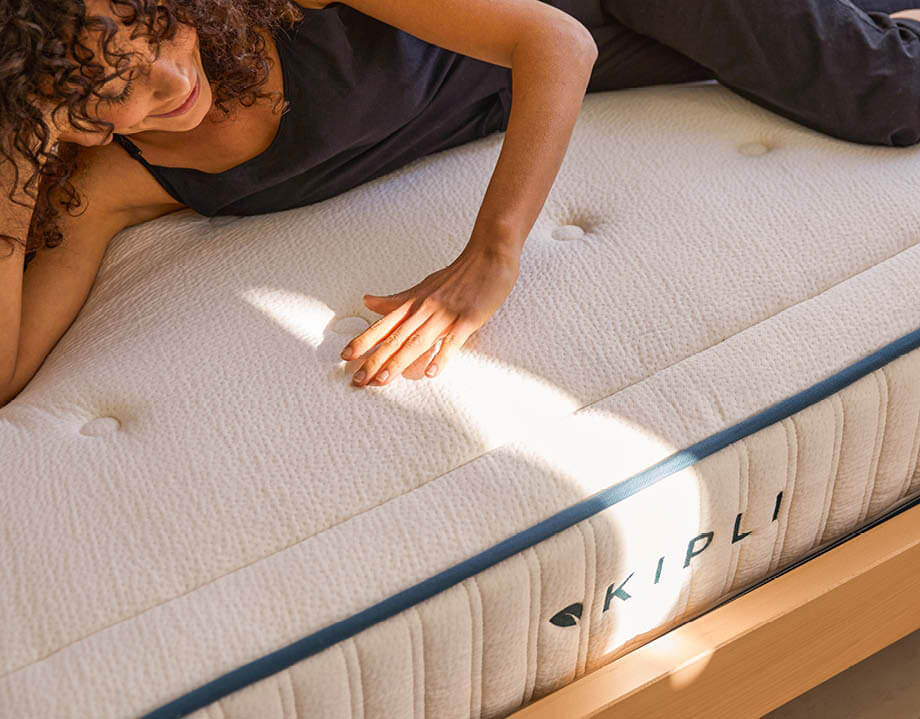
Kipli, 100% natural latex mattresses
From the very beginning, Kipli's goal has been to create and sell a mattress made from 100% natural latex.
For the end customer, there’s no comparison between choosing a truly 100% natural mattress and one made from a blend of materials—that’s why we’ve focused entirely on a natural, high-end product.
It often happens that a customer buys a blended latex foam mattress because they haven’t fully understood the difference between blended latex foam and 100% natural latex. The customer is drawn to the prospect of saving a little money, but this ultimately leads to lower satisfaction—which, in the long run, is far more important than the small savings achieved.
Sleeping on a 100% natural, top-of-the-line mattress like Kipli is priceless. Just think: a mattress is used for an average of 7 years—that’s roughly 2,555 nights, or about 20,440 hours. Choosing a 100% natural latex mattress like Kipli guarantees excellent rest and good health.