

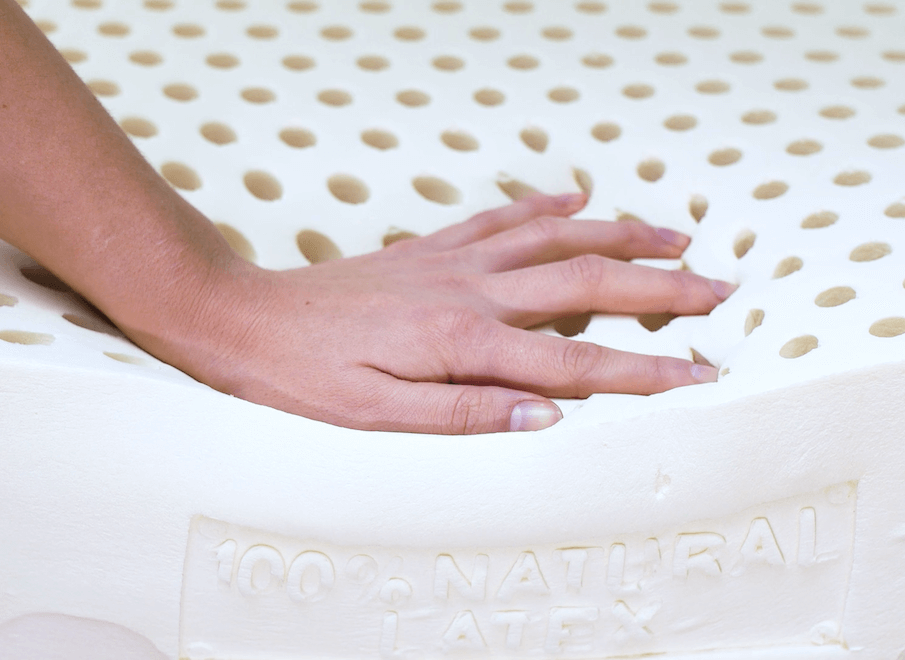
A mattress can be considered an anti-gravity device, and the key requirement is certainly its ability to perfectly conform to the body’s anatomical curves (in particular, the classic double “S” shape of the spine:the physiological curves). That is why, in this article, we will outline the main benefits of natural latex mattresses. But first, let’s go over some basics about the structure of our spine.
Understanding Your Spine to Reap the Benefits of a Latex Mattress
The spine can be divided into four regions, which, starting from the top, we can call: cervical, thoracic, lumbar, and sacral. In adults, it is straight in the frontal plane (otherwise we would refer to it as scoliosis) and divides the body exactly into two symmetrical parts, while in the sagittal plane it has four curves:two with anterior curvature and two with posterior curvature. The anterior curves are in the cervical and lumbar regions and are called lordosis, characterized by mobility, while the posterior curves are in the thoracic and sacral regions and are called kyphosis, characterized by rigidity. It is precisely this alternation between more mobile curves (lordosis) and more rigid curves (kyphosis) that allows us to maintain an upright posture while also providing great flexibility and mobility, thereby properly distributing mechanical stress.
Curves and flexibility are important factors in counteracting the force of gravity and other external forces.
Bones, muscles, joints, and the lower limbs are designed to bear weight and provide support and balance for the trunk. The physiological curves are therefore beneficial for the spine, giving it a greater ability to absorb pressure and stress. It is normal to have a certain degree of lordosis and kyphosis; it is not normal for them to increase (hyperlordosis and hyperkyphosis), but it is also not beneficial for them to decrease. Work and sports activities—as well as a sedentary lifestyle—force us to adopt postures that alter the physiological curves.The lumbar region of the spine supports the entire weight of the upper body; this weight is transferred to the pelvis when sitting and to the legs when standing, walking, or running. Consequently, this is the region where pain occurs most frequently. This is why the lumbar vertebrae are necessarily more developed in order to to support the increased load placed on the lower back.

Why Choose the Benefits of a Latex Mattress
When lying down, the body’s natural curves must therefore be supported, and for this to happen properly, the mattress must be able to conform to those curves in proportion to the pressure exerted by the body as precisely as possible. This is all the more important given that sleeping positions can vary in countless ways—from lying on one’s back to lying on one’s stomach—and particularly include the most common fetal-style side position, which is especially critical when evaluating a mattress’s comfort. In fact, it is in the side position that the mattress must provide the greatest amount of give to allow the shoulder area to sink into the support sufficiently to ensure that the anatomical curves of the spine, as shown in the figure, are properly supported.With regard to this objective, which pertains strictly to anatomy, it can be demonstrated that the use of natural latex foam (a natural elastomer) with a precise response and maximum elastic capacity (an elastic modulus approximating a constant (K) at least within the range of stresses applied by the body, i.e., approximately between 1 and 10 g/cm²) is the best possible solution for the required performance. An elastomer is defined as a material capable of undergoing significant deformation under the action of relatively small forces and of rapidly recovering its original shape and dimensions as soon as the force is removed. Natural latex is the elastomeric material par excellence. In the laboratory, stress-strain hysteresis curves can be plotted, showing the material’s deformation under stress followed by release and return to its initial position, which highlight the astonishing elastic capacity of vulcanized natural latex.
These tests clearly show that, with respect to the required property (deformation proportional to the force exerted by each individual infinitesimal area of the body), natural latex—within the scope of application required for a mattress—exhibits the proportional behavior most similar to Hooke’s ideal law; not only that, but it is also the only material that does not exhibit inflections (changes in the concavity of the curve) within the performance range; furthermore, it is the material that exhibits by far theless energy loss between the supply (loading) and return (unloading) And since the energy dissipated—corresponding to the area between the two forward and return curves—is essentially converted into heat, one can appreciate the importance of performance from the perspective of the microclimate during rest as well.
We would like to take this opportunity to explain why Kipli focuses its attention on the mattress and pillow system: because, unlike traditional manufacturers and their stores, we know full well thata pure natural latex mattresswiththe thickness and density engineered by Kipli is capable of providing excellent performance in terms of stress/deformation, as well as—as we will see—microclimate, hygiene, environmental safety, breathability, and hypoallergenicity—regardless of the type of support structure(slatted frame, bed, or box spring) on which it may be placed, to which the sole task of adjusting the head or foot sections may be relegated, if required.
This observation stems from the “zero-budget” design approach followed by our engineers, who first identified the required performance specifications and then evaluated the available materials to provide maximum value to the user while avoiding duplication of functions between the support structure and the mattress.